
Illustrative courtroom sketch. Mike "The Situation" Sorrentino was sentenced October 5, 2018, in federal court in Newark, NJ.
Mike "The Situation" Sorrentino did 8 months in federal prison. The thing that put him there wasn't the tan or the reality show. It was splitting cash deposits to stay under $10,000.
He'd heard what a lot of small business owners have heard. Banks report cash deposits over $10K to the IRS. So he started depositing $9,500 here, $7,200 there, breaking up the cash from his appearance fees so no single deposit crossed the line.
That move has its own federal statute. It's called structuring. It cost him 8 months in prison, $123,913 in restitution, and a $10,000 fine on top of his back taxes.
I built CheckDeposit in 2019 as a free deposit-slip tool, and I've watched 81,000 deposit slips flow through it since. Last week alone, our users brought $23,000, $19,308, and $15,000 in cash to the counter. Every one of those deposits triggered a report to the IRS. None of those depositors did anything wrong.
The rule isn't a trap. It's just a rule, and most small business owners don't know the details. Most of it is simpler than it sounds. The mistakes that send people to federal prison are not.
The smart cash depositor's checklist
Five things to do if you handle cash regularly, in order of how much trouble they save you:
- Deposit the full amount, and don't try to be clever about it. The cash you legitimately took in won't hurt you, but the cash you tried to hide will.
- File Form 8300 when a single customer pays you more than $10,000 in cash. Set a calendar reminder for the 15-day deadline.
- Keep a receipt for every cash expense, no exceptions. Scan them the same day, because the expense side is where audits go bad.
- Separate business cash from personal cash. One business account, one business debit card, one business credit card.
- Talk to a CPA before any cash-deposit pattern looks unusual. A 30-minute call is cheaper than a federal prosecution.
The rest of this article walks through each rule in plain English, with the real cases that show what happens when small business owners get it wrong.
What the IRS sees when you deposit cash
Walk into a bank with more than $10,000 in cash, and the bank files a Currency Transaction Report with FinCEN within 15 days. The teller fills it out behind the counter while you stand there, and you don't sign anything.
The threshold is $10,000 in cash in a single business day, across all your transactions at that bank. Deposit $6,000 in the morning and $5,000 in the afternoon at the same branch, and the bank files the report. The $10,000 line isn't per deposit. It's per day, per customer.
So does that mean the IRS sees nothing below $10,000? Not in real time, no. But the IRS can pull every deposit you've ever made if they audit you, so the line isn't a force field. It's just where the alarm rings automatically.
This is federal law under the Bank Secrecy Act. The Treasury Department set the $10,000 number in the early 1970s and never adjusted it for inflation.
That's part of why the line catches so many small businesses today. A $10,000 cash day in 1972 was serious money, but a $10,000 cash day in 2026 is a busy weekend at a food truck.
Form 8300: when YOU have to file (not the bank)
I've talked to a lot of small business owners who never heard of Form 8300. It's the one cash rule where the paperwork lands on YOUR desk, not the bank's.
Here's how it works. Your business takes in more than $10,000 in cash from one customer in one transaction. You then have 15 days to file Form 8300 with the IRS. The form asks for the customer's name, address, taxpayer ID, the amount, and what they bought.
What counts as "one transaction"? Related cash payments from the same buyer across 24 hours add up. Two $7,000 cash payments on the same Tuesday from the same buyer count as $14,000, and that's one filing.
The rule covers any trade or business that handles cash. That includes car dealers, jewelers, real estate agents, contractors taking a big cash payment, and attorneys getting paid a retainer in cash. The IRS uses Form 8300 to cross-check the customer's return, not yours. The filing obligation is still yours, and the penalty for skipping it can stack up fast.
The fix is simple. If your business is going to take in over $10K cash from one customer, file the form. The IRS has an e-file system, and it takes a few minutes.
Structuring: the trap that got Sorrentino
Here's where Sorrentino got himself in trouble. He didn't deposit $15,000 once, he deposited $7,500 twice on purpose to stay under the radar. That move has its own federal statute attached to it.
Splitting one deposit into two to dodge the $10,000 rule is a federal crime called structuring. It carries up to 5 years in prison under 31 U.S.C. § 5324. And the law doesn't care whether the cash itself was clean.
Yogesh Gandhi from Pleasant Hill, California got 2 years in federal prison for structuring $156,000 across 18 cash deposits. Every dollar was legal. He still went to prison for 2 years because he split the deposits on purpose to avoid the bank reporting requirement.
This is the part most small business owners miss. The $10,000 rule isn't there to punish you for depositing $10,001. It's there to flag patterns, and a single $15K deposit triggers paperwork. Two $7,500 deposits on the same Tuesday is the pattern Congress wrote § 5324 to catch.
Don't get clever. Deposit the full amount, let the bank file the paperwork, and move on with your day.
What the IRS sees on smaller deposits
I'll be straight with you. A $3,000 cash deposit on a Tuesday doesn't set off any alarms in real time. The IRS isn't watching your bank account on a screen somewhere.
But if you get audited, the IRS can subpoena every deposit you've ever made. Your bank hands over the whole list, and "invisible" turns into "invisible until somebody starts looking."
What does that mean in practice? A single small cash deposit doesn't create paperwork, but a pattern of small deposits totaling six figures a year does, the moment the IRS decides to look. Your bank keeps the records for at least 5 years, and the IRS can go back further if they think there's reason to.
So the practical answer to "does the IRS see my $400 cash deposit at Wells Fargo on Monday" is: not today, maybe never, definitely if there's an audit.
What we see at CheckDeposit (really interesting cash deposit data)
We've watched 81,529 deposit slips flow through CheckDeposit since 2019, from 38,000 businesses. When we ran the last 100 deposits this week, 34 included cash.
The businesses depositing cash this week look like real life. One funeral home brought $2,000 in cash plus a $2,232 check. A church dropped off $5,000 in tithes. A small medical office deposited $510 in copays, and a golf pro put $4,360 from lessons in his account.
A contractor walked in with $6,000 in cash. One small business deposited $23,000 in cash at US Bank. Another brought $19,308 in cash to a Netspend prepaid account. Both of those crossed the $10,000 line on a single day and triggered a CTR automatically.
71% of the cash deposits we saw last week were cash-only, no checks alongside. That's the signal of a real cash-handling small business. We see funeral homes, churches, contractors, small medical practices, golf pros, and food trucks every week. They take payment in cash often enough that they print their own deposit slip instead of asking the bank.
Cash isn't a fringe payment method in small-business America. A lot of small operations still run on it, and most of the people running them don't know the IRS rules because nobody bothered to write them down in plain English.
Why cash businesses get audited more
The IRS has a 17-chapter book on how to audit cash businesses. It's called the Cash Intensive Businesses Audit Techniques Guide, and you can read it.
The first thing an examiner does is calculate the ratio of cash to credit-card deposits. If your cash percentage looks high for your industry, you've already moved up the queue. The examiner then walks through what the IRS calls the "source and application of funds" method. How much money came in, how much went out, and do the numbers reconcile with what you reported?
That doesn't mean every cash business gets audited. It means cash businesses get audited at higher rates than salary-only filers. The IRS has a specific playbook for it, and the playbook is public.
A real case: Sandy's restaurant in Plymouth, Massachusetts
Rudolph Ferrucci ran a seasonal cash-only restaurant called Sandy's in Plymouth, Massachusetts. He kept a second set of books in a notebook to track the $315,000 in cash wages he was paying his employees off the records.
He wasn't running organized crime, he was running a restaurant. The cost: six months on home confinement, 400 hours of community service, and a $5,500 fine. The second set of books cost him a lot more than the $75,000 in employment taxes he tried to skip.
The IRS didn't catch him because of a single big cash deposit. They caught him because the cash on his books didn't match the cash flowing through the business. Once they pulled the bank records, the math didn't work, and the handwritten notebook turned up in the investigation.
The lesson isn't "don't be a criminal," it's "don't keep a second set of books." If your business runs on cash, your books need to show it.
The real risk: the expense side, not the income side
Here's the part most people miss. In a real cash-business audit, the deposits aren't usually what sink you, because the bank statement proves what came in.
What sinks you is the cash you spent. The supplies you bought from a guy at the farmers market for $400, the subcontractor you paid in twenties, the gas you put in the truck. If you can't show a receipt, the IRS won't let you deduct it, and that means you owe tax on every dollar you can't prove you spent.
This is what nobody tells cash-handling small businesses: the bank statement covers the income side, but nothing covers the expense side except the paper receipts you remember to keep, and cash receipts end up in a glove compartment, a coat pocket, or a kitchen drawer.
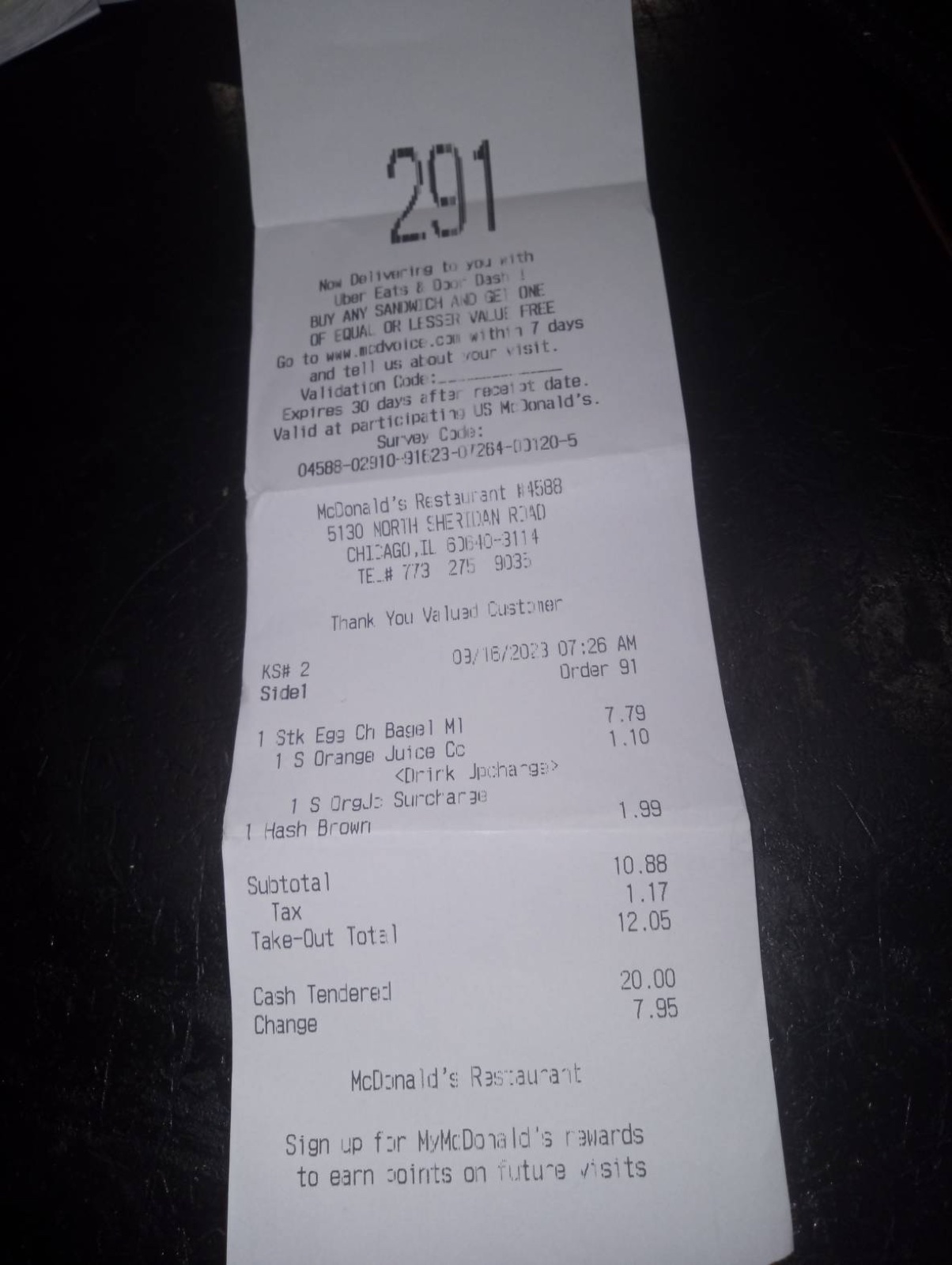
Real customer scan: a $12.05 McDonald's breakfast in Chicago, paid in cash. Cash Tendered $20.00, Change $7.95. This is the small everyday business receipt that's easy to lose.
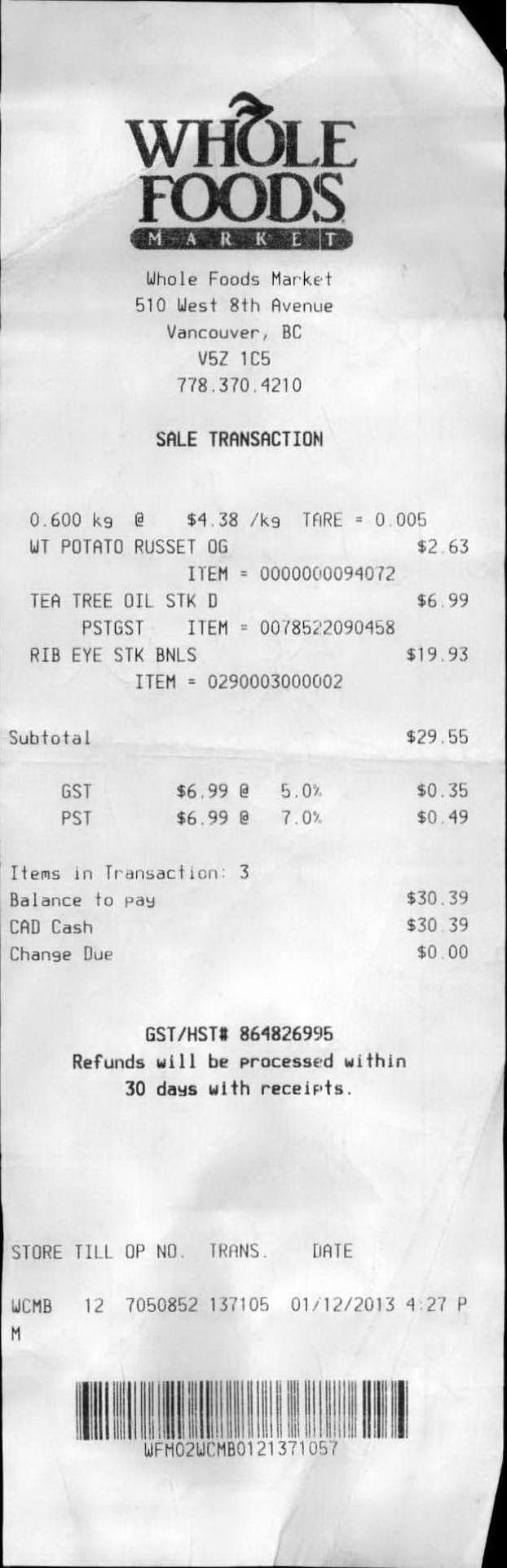
Real customer scan: a $30.39 cash purchase at a Vancouver Whole Foods. A potato, some tea tree oil, and a ribeye steak. This is the working-lunch receipt that goes missing the moment you put it in your pocket.
Both of these receipts are real customer scans from Shoeboxed.
FAQ
How much cash can you deposit at once without it getting reported? You can deposit any amount you want. The question is whether the bank files a CTR, and the answer is yes if it's over $10,000 in a single business day, no if it's under. The moment you start splitting deposits on purpose to stay under, you've crossed into structuring.
Do banks report cash to the IRS? Banks report cash transactions over $10,000 in a single business day. They also report suspicious patterns at any amount. Below $10K with no suspicious pattern, no report goes to the IRS.
Can the IRS see my bank deposits? Not in real time, and not unless they're auditing you. But in an audit, they can pull every transaction from every bank you've ever used, going back as far as they need.
What happens if you deposit more than $10,000? The bank files a Currency Transaction Report with FinCEN, and that's it. If your taxes are clean, nothing else happens. The CTR exists to track patterns, not to flag individual legitimate deposits.
Is depositing cash suspicious? Depositing cash isn't suspicious. Splitting cash deposits to stay under the $10K reporting threshold is suspicious, and it's also a federal crime called structuring under 31 U.S.C. § 5324.
PS from Doug
I'm Doug, founder of CheckDeposit. I built it in 2019 after I left Earth Class Mail, and I bought Shoeboxed last November.
Are you a small business owner or contractor with a pile of receipts to keep straight for tax time? Shoeboxed scans and files all of them. Your books stay clean, and you can write off everything you're entitled to. Real humans in North Carolina do the hard part, there's a risk-free trial, and if it's not for you, no hard feelings.
Sources:
- Form 8300 and reporting cash payments over $10,000 — IRS
- FinCEN Educational Pamphlet on the Currency Transaction Reporting Requirement
- 31 U.S.C. § 5324 — Structuring transactions to evade reporting requirement prohibited
- IRS Internal Revenue Manual 4.26.13 — Structuring
- IRS Audit Techniques Guides (ATGs) index
- Former owner of Plymouth restaurant sentenced for tax evasion — IRS-CI
- Michael "The Situation" Sorrentino sentenced — DOJ USAO-NJ
- Yogesh Gandhi structuring sentence — DOJ Tax Division archive