
A customer is on the phone and wants to pay you by check, right now, without mailing anything. You can take that payment, as long as the person is already your customer or they called you. It's legal, and it's routine. The customer reads you the numbers off the bottom of a paper check and says yes out loud. The money comes out of their bank account, with no envelope and no waiting on the mail.
One rule decides whether that payment holds up or gets reversed later, and most small business owners have never heard of it. You have to record the customer saying yes, or send them a written confirmation before the money moves.
I built CheckDeposit in 2019 as a free deposit-slip tool, and 81,529 deposit slips from 38,000 businesses have flowed through it since then. The heaviest users we see are medical practices, law firms, staffing agencies, and nonprofits. If that sounds like your business, sooner or later a caller asks: "Can I just give you my account number over the phone?"
The phone-payment checklist
Do these five things when you take a check payment by phone:
- Only take a phone payment from an existing customer, or from someone who called you. The payment network's rules don't allow you to cold-call a stranger and pull money from their account, even if they say yes on the call.
- Write down the details and read them back: the name on the account, the routing and account numbers, checking or savings, the amount, the date, and an email address for the confirmation.
- Get a clear spoken yes that covers the amount and the date. Silence doesn't count as consent.
- Record that yes, or send a written confirmation before the money moves. You need one or the other, or the payment may not hold up if the customer disputes it.
- Keep the recording or the confirmation for two years from the date they said yes. The network's rules set that window, and the day a customer says "I never agreed to that," this proof settles it.
Not set up to pull bank payments yet? You can still take the call today. Collect the details, get the yes, and date the payment a few days out while you get one of the options below switched on.
Taking checks by phone is legal, and it has a name
A phone check payment moves through the ACH network, the bank-to-bank system that also handles direct deposit and automatic bill pay. Nacha, the organization that writes the rules for that network, calls this payment a TEL entry, short for telephone-initiated. A TEL entry is a bank payment the customer approves out loud on the phone.
You've made this payment yourself if you've ever paid a phone or utility bill by reading your account number to the person on the line.
The main boundary is the relationship. The rules allow a phone payment when the person is already your customer, or when the customer placed the call to you. Calling one of your own customers back about a balance counts too; the rule exists to stop cold calls to strangers. If the relationship is brand new and you dialed the phone, mail an invoice instead.
One more wrinkle worth knowing: the yes has to come from whoever owns the account being paid from. A patient's husband paying his wife's bill from his own account is fine. He's authorizing his own money, and his call to you satisfies the rule.
These rules are written for payments from personal accounts. If your caller pays from a business account, keep the same script and the same written confirmation anyway, and your bank or processor will handle any paperwork differences.
The two ways the money moves
A phone check payment happens one of two ways.
One path is an electronic payment. You give the routing number, account number, and amount to your bank or the service you use to take payments, and the network pulls the money from the customer's account. No paper changes hands. The Nacha rules in this article cover this path, and it's the one most payment services offer.
The other path is a printed check. Some check-printing services turn the customer's information into a paper draft. A paper draft is a printed check that pulls from the customer's account, with a line like "no signature required" where the signature would go. You deposit it like any other check, and this path never touches the ACH network. Keep the same proof of the customer's yes anyway, in case the customer ever says they never agreed. If you make that deposit with a paper deposit slip, we print deposit slips for free for any US bank.
The one rule: record the yes, or confirm it in writing
Under Nacha's rules, a spoken yes for a one-time phone payment counts only if you do one of two things:
- Record the customer authorizing the payment, and keep the recording.
- Send the customer a written confirmation of what they agreed to, before the money comes out of their account. Regular mail and fax work. Email and text work too, if the customer agrees to receive it that way first (the script below asks for that OK).
The confirmation is short. It needs:
- The amount
- The date the money comes out
- The customer's name
- The account the money comes out of (the last four digits are enough)
- A phone number they can reach you at
- How they can cancel
- The date they said yes
- A line saying it's a one-time payment
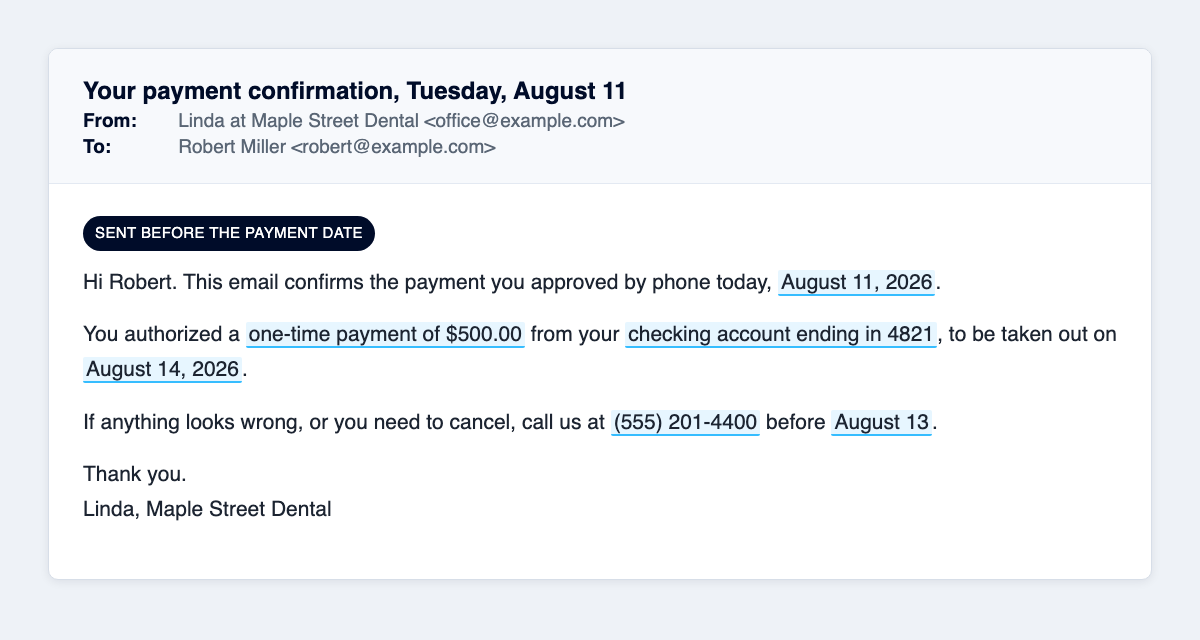
Here's a confirmation email you can copy and fill in. Make the cancel-by date the day before the payment date:
"Hi [name]. This email confirms the payment you approved by phone today, [date of the call]. You authorized a one-time payment of [amount] from your [checking or savings] account ending in [last four digits], to be taken out on [payment date]. If anything looks wrong, or you need to cancel, call us at [your phone number] before [cancel-by date]. Thank you. [Your name and business name]"
Whichever option you pick, keep the proof for two years from the date they said yes.
Recording comes with two catches. Some states require both people on a call to agree to the recording, so ask for permission first. And stored recordings fill up with account numbers, plus card numbers if you take cards on the same line. Protect them like paperwork: delete recordings you no longer need, and keep the rest somewhere private. Offices that run their phones through a help desk like Zendesk can redact Zendesk call recordings before the audio ever reaches storage.
If I were taking my first phone payment this week, I'd skip the recording and send the email. It's less to manage, and there's no consent question to worry about.
What to say on the call
Start with the numbers. A line that works: "Grab one of your checks, and read me the numbers printed along the bottom, starting from the left."
Collect seven things, and repeat each number back as they read it:
- The name on the account
- The routing number (the nine digits at the bottom left of their checks)
- The account number (printed next to the routing number on the check)
- Checking or savings
- The amount
- The date you'll pull the payment (the next business day works if you're already set up; give yourself a few days if you're not)
- Their email address, if you're sending the confirmation by email
One wrong digit kills the payment, and your customer is reading tiny numbers off a check in a desk drawer. Two quick safety nets: a routing number always has nine digits, so recount if you wrote down eight or ten. And if they don't have checks handy, both numbers sit in their online banking under account details.
Then get the authorization. If you record calls, start the recording, ask for permission on tape, and read this with your own amount and date:
"May I record this call to confirm your payment authorization?"
"Thank you. I'd like to confirm you're authorizing a one-time payment of [amount] from your account on [date]. Can you confirm with a yes?"
If you send a written confirmation instead of recording, swap the first question for: "Is it OK if I email you a confirmation of this payment today?" Then send it before the payment date, and keep a copy in the customer's file, on paper or as a saved email.
One last piece of housekeeping. Once the payment has run and the confirmation is saved, shred the page you wrote the numbers on. Keep the authorization, not the account number.
Where to run the payment
You have the numbers and the yes. Now somebody has to move the money, and you have four options:
- Your business bank. Many business checking accounts can pull an ACH payment from a customer's account through online banking. Call your banker and use these words: "I want to originate an ACH debit." They'll know exactly what you mean.
- A payment processor. Stripe, Square, and QuickBooks all offer bank payments (some services call them echecks, which is short for electronic checks). Stripe, for example, charges 0.8% capped at $5 per payment.
- Your invoicing software. If you bill through an accounting or invoicing tool, look for a bank payment or ACH option in its payment settings. It's often already there, waiting to be switched on.
- A check-printing service. The printed-check path needs nothing but check-printing software and your regular bank account. I don't have a favorite to recommend here, so compare a couple before you pick one.
None of these run a payment the minute you sign up, because a new account needs a setup step or a call to the bank first. If the customer is on the phone right now, take the details, get the yes, and set the payment date a few days out. The authorization covers it.
What it costs, and when the money lands
A card processor takes a percentage of the whole payment. A bank payment costs a flat or capped fee, and that fee doesn't grow with the invoice.
If your card processor takes around 3%, a $2,000 invoice costs about $60 in card fees. The same payment through Stripe's bank-payment pricing costs $5, because the fee caps there. The median check in our data is $400, and at 3% the card fee on it is about $12. (Staffing agencies write the biggest checks we see, a median of $6,354, and at 3% one of those costs about $190 to run as a card.)
The money lands in about two to four business days. Stripe, for example, pays out in four business days on its standard schedule, or two if you pay a higher rate for a faster payout.
What can go wrong, and how to protect yourself
When a phone payment fails, it fails one of two ways, and both have a simple defense.
The account can be short. A phone payment can bounce for insufficient funds, the same as a paper check. When that happens, ask the customer for a new date, get a fresh yes, and run it again.
The customer can dispute it. The customer gets 60 days to claim they never authorized the payment, and the clock starts on the bank statement that shows it. If that happens, their bank asks you for proof. Your recording or written confirmation is that proof.
A phone payment is not dispute-proof, no matter what a payment company's website says. The customer's bank can pull the money back, and the authorization you kept on file is what settles the question in your favor.
Who still pays by check: what we see at CheckDeposit
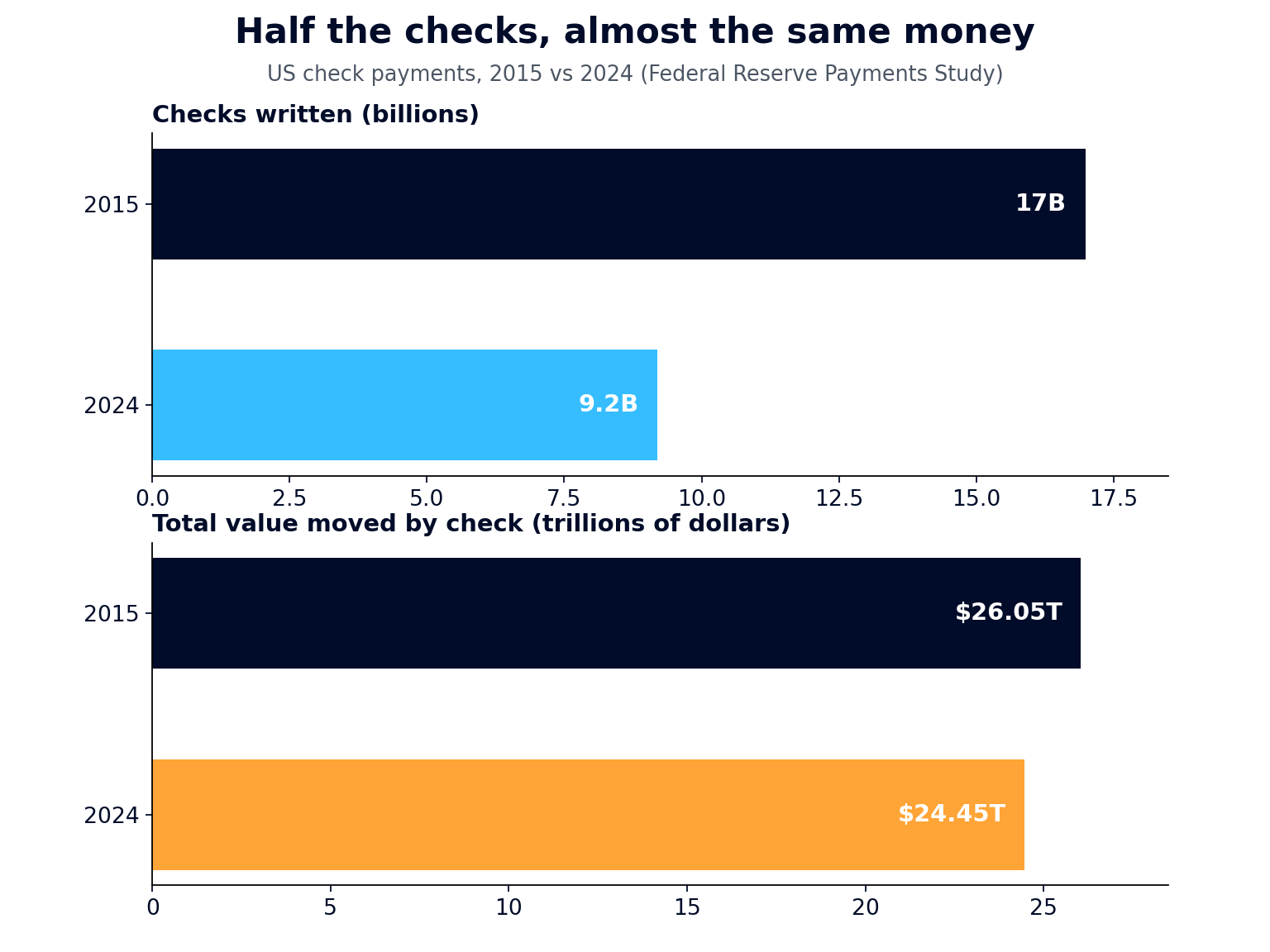
The Federal Reserve counted 9.2 billion check payments in 2024, worth $24.45 trillion. Nine years earlier, Americans wrote 17 billion checks worth $26.05 trillion. That's half the checks moving almost the same money, and it means the average check grew from about $1,500 to about $2,700.
We watch those numbers play out one deposit slip at a time, about $1 billion in checks so far. Genecov Orthodontics has printed 541 deposit slips with us. The Williams Syndrome Association, a national nonprofit, has printed 260. Game 7 Staffing has printed 191, and Rose Law Firm has printed 106. Every one of them still runs on checks in 2026, and if you're wondering where paper checks go from here, we walked through seven years of our own data in are paper checks going away.
Common questions about check by phone
What is a check by phone payment? It's a bank payment the customer approves out loud over the phone, using the same routing and account numbers printed on the bottom of their paper checks. It moves through the ACH network, the system that also moves direct deposits.
How do you do a check by phone? Ask the customer for the name on their account, the routing and account numbers, the amount, and the payment date. Get a spoken yes that covers the amount and the date, record it or send a written confirmation, then run the payment through your bank, a processor, or your invoicing software.
Is check by phone safe? It's safe for the customer, because federal rules let them dispute an unauthorized payment for 60 days after it shows on their statement. It's safe for you when you keep the recording or written confirmation, because that's the evidence their bank asks for. Protect the numbers themselves too, and don't leave account numbers sitting in notes or stored call audio.
Do I have to record the call? No. Recording is one of two options, and the other is a written confirmation sent before the money moves. Businesses that don't want to manage recordings, or that work in states with strict recording-consent laws, send the confirmation instead.
Can I take a repeating payment this way, like monthly rent? Yes, but the rules are stricter for repeating payments: the customer needs a written copy of the authorization terms (what's being paid, how much, how often, and how to cancel), not just a phone call. The cleanest route is a processor or invoicing tool that saves the authorization and handles that paperwork for you. The script in this article covers the one-time payment.
Does the caller have to be my customer? Not always. The yes has to come from whoever owns the bank account, so a spouse or family member can pay from their own account. If they placed the call to you, the no-cold-call rule is satisfied too.
What happens if a customer disputes the payment? Their bank contacts your bank or processor and asks for the authorization you kept.
PS from Doug
I'm Doug, founder of CheckDeposit. I built it in 2019 after I left Earth Class Mail, and I bought Shoeboxed last November.
If checks come in your front door, receipts pile up in the back. Shoeboxed turns that pile into organized, tax-ready records. Snap a photo in the app, forward an email, or mail the whole pile in and a real team in North Carolina scans it for you. There's a risk-free trial, and if it's not for you, no hard feelings.
And if some of your customers still pay in cash, our cash deposit rules guide covers the $10,000 reporting line and the mistakes that get small businesses in real trouble.
Sources:
- Nacha ACH developer guide: Standard Entry Class codes, including TEL
- Telephone-Initiated Entries (TEL) Guidelines (TWIA agent guidance)
- Regulation E, 12 CFR 1005.11: error resolution and the 60-day window (CFPB)
- Federal Reserve Payments Study: national payment volumes 2015-2024
- Stripe: ACH Direct Debit timing and disputes and pricing